

Enabling fair and secure energy data sharing for Digital Twins with ESDL
For the next four years (2027-2031), TNO will work on community building for the Federate project, led by TUDelft, and will ensure the results from
A single language with which energy models and tools can exchange information. From electricity and heat grids to hydrogen, from solar to wind.
Whether you are a policymaker, energy consultant, or software developer — ESDL has something to offer everyone.
Learn what ESDL is, why it was developed, and how it supports the energy transition.
Integrate ESDL into your own model with pyESDL, the Flask template, or the Excel converter.
ESDL was developed by TNO to better model the increasingly complex energy transition. The language makes it possible to describe energy systems in a structured and uniform manner.
ESDL brings components, parameters, space, time series, and market information together in a single language.
Producers, consumers, storage, transport and conversion with technical characteristics.
Areas, locations, infrastructure, and hierarchy from region to district.
Demand, production, weather, costs, and other time series for simulations.
Costs, CO2, energy neutrality, markets and asset management.
Companies, universities, grid operators, and governments are collaborating on the energy transition with ESDL. You can find the current partners via this link . Email us to add your name, project, and ESDL-compatible solution.
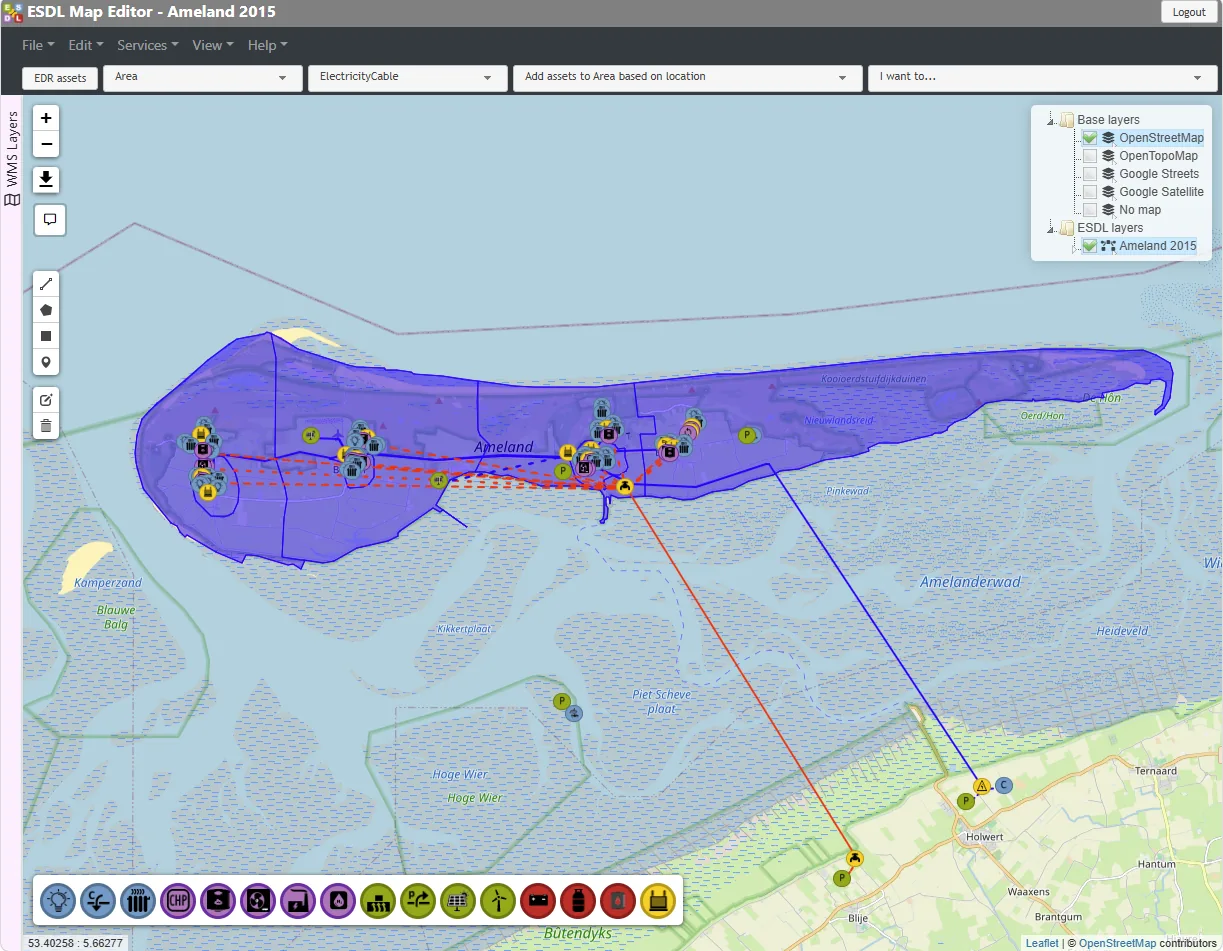
The map-based web application that allows you to assemble an energy system by clicking together an energy system on the map with the mouse.
News, articles, and developments from the ESDL community.
For the next four years (2027-2031), TNO will work on community building for the Federate project, led by TUDelft, and will ensure the results from
Omgevingsdienst Midden Holland has explicitly chosen ESDL in its market consultation for the development of a scenario planning tool for several of its municipalities. https://www.tenderned.nl/aankondigingen/overzicht/426222
Esri, the company behind ArcGIS, is experimenting with ESDL and exploring an ESSIM simulation from within ArcGIS within the European project 3DxVERSE.
ESDL describes energy systems at the planning abstraction level and supports more than 20 modeling areas. Components are classified into five types: Consumption, Production, Storage, Transport, and Conversion. ESDL supports a wide range of energy carriers, buildings, profiles, KPIs, and energy markets. Limitations: occupant presence, policy aspects, and time-dependent gas compositions are not yet supported.
Ready to get started? Contact us for more information or check out the developer resources.